Inside the laser engraving process for branded tumblers
A step-by-step look at how a customer logo becomes a permanent laser engraved mark on a corporate drinkware gift, from vector file to first article.
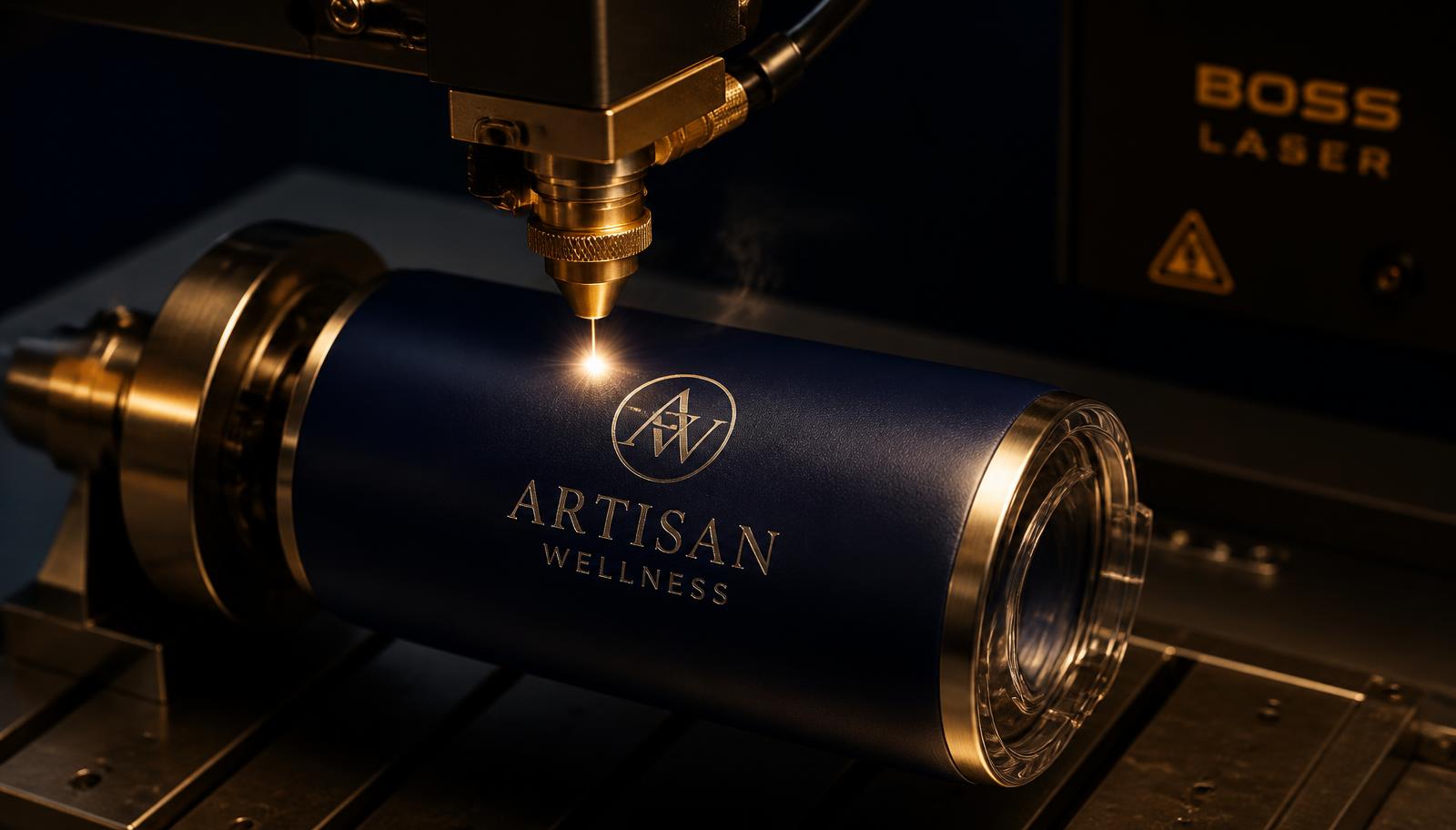
Every engraved gift starts as a file, not as a machine setting. The first thing our engineering team does with new artwork is convert it to clean vectors, remove gradients that a laser cannot reproduce, and set the minimum stroke weight so fine serifs and registered-trademark marks stay legible at 25 mm wide.
The tumbler is then fixtured on a rotary chuck so the body turns at a constant speed under a fixed fiber laser head. Rotary engraving is what keeps a wrap-around logo from stretching at the edges — a flat jig would distort anything wider than about 60 mm of arc.
Power, frequency and speed are dialled in on a scrap unit first. On powder-coated stainless we typically run a low-power pass that removes only the coating layer, exposing bright steel underneath for a two-tone reveal. On bare steel we run hotter and slower to etch an oxide mark directly into the metal.
Each new job gets a first-article sample photographed against a grey card and sent for written approval before the batch runs. That single approval step prevents almost every rework claim we see in corporate gift programs.
Production then runs in trays of forty, with an operator checking mark depth and position every tray against the approved sample. Engraved marks cannot be corrected after the fact, so inspection is inline rather than at the end.
Lead time for a standard engraved drinkware order is 7 days for sampling and 15–20 days for production at 500–5,000 units, before freight.